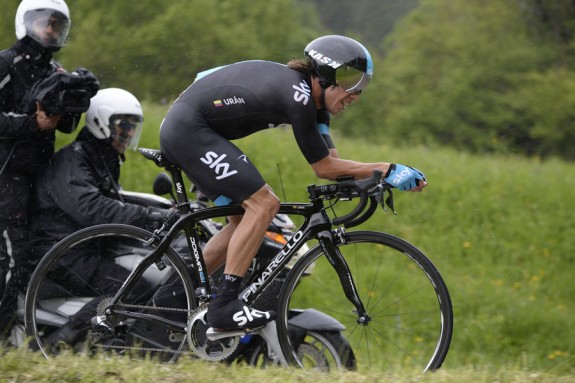
One of the main milestones of road cycling is the 100 mile or “century” ride.
In the Houston Tx area, there are quite a few decent options for 100+ mile rides–both solo and in groups.
By far the biggest century ride near Houston every year is the annual MS150 ride–from Houston to Austin. Depending on where you start in Houston the first day (Houston to La Grange) can easily be a fun century ride–whether you are doing the full ride to Austin or not. Many groups will stage cars in the Fayetteville / La Grange area the night before, ride the +/- 100 miles from Houston to Fayetteville / La Grange–then drive back to Houston. (There are also a few groups that continue on to Austin the same day and do 160 to 200 miles in one day. This ride is informally referred to as H2A (Houston to Austin).)
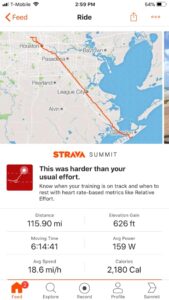
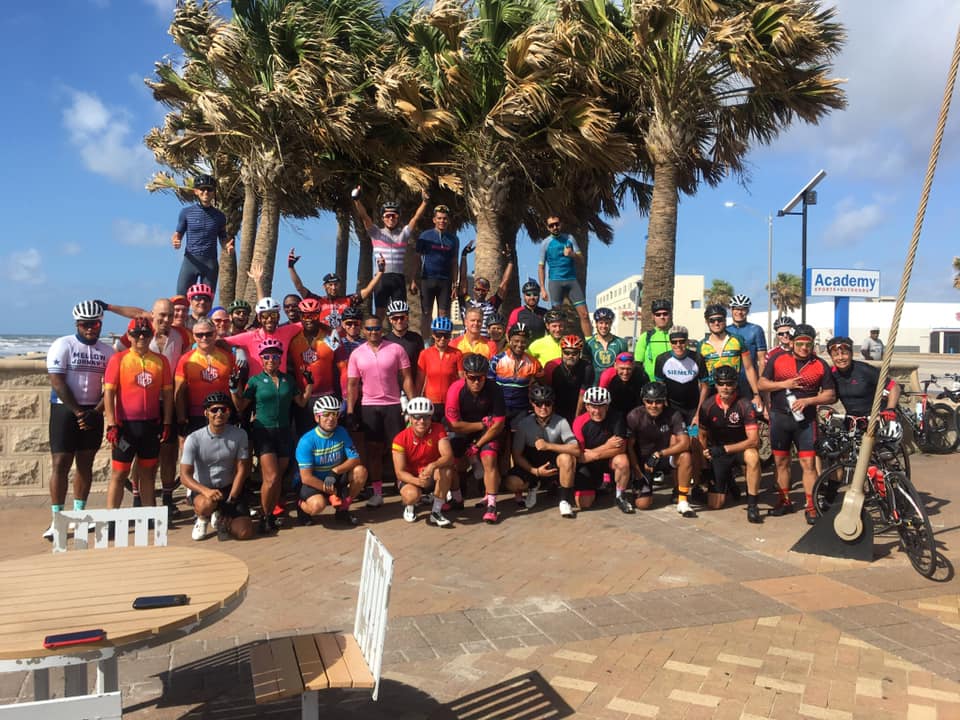
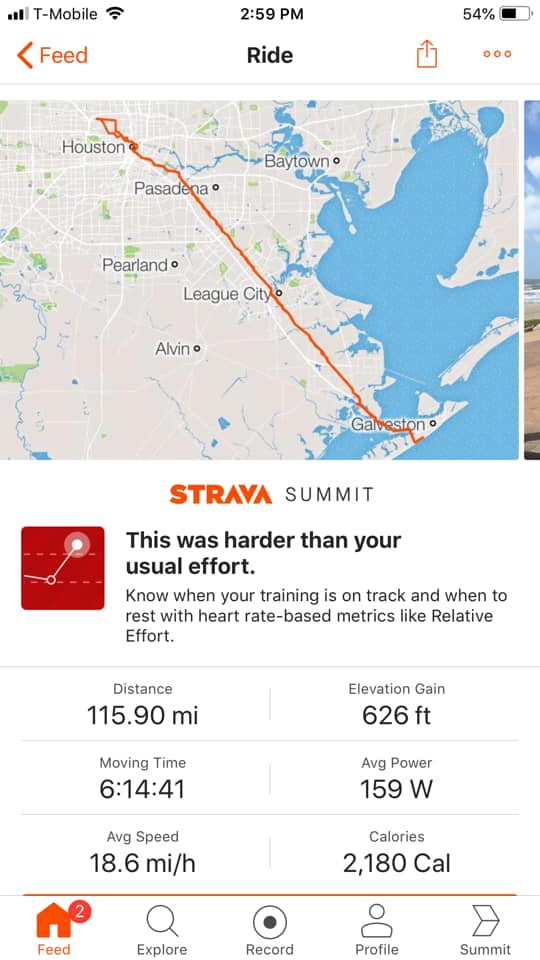
Another regular century ride in the Houston area is the H2G series (Houston to Galveston). A large and every changing / growing group do this ride about once every 3 months. This ride is free but is somewhat supported. Plus, since it starts and ends downtown, you’re never more than +/- 50 miles from home–so it’s usually easy to get picked up by friends or family in the event of a major mechanical, fatique, weather–or a crash. (We recommend you avoid the summer rides unless you want to get heat stroke. The spring / fall / winter rides are much more enjoyable.)https://www.mapmyride.com/routes/view/752306853
The Katy Flatlands Century is one fo the few, organized, supported century rides in the Houston area. It is an annual event that–unfortunately and inexplicably–takes place in the heat of the summer. If you do the KFC–start EARLY–even before the official start time–to avoid the hottest part of the day. @ 20 mph avg you’re looking at 5 to 6 hrs (w/ rest / bathroom stops)… so even a 6 am start puts you back @ the finish around mid day.
Combining TWO or more group rides–or a long group ride with a shorter solo ride–is another great way to ride a century in the Houston area. Most regular / organized group rides of any real distance usually start fairly early on weekend mornings–to avoid the heat of the day. However, “Noon Bike” is a ride in central Houston that starts at noon on Sundays and has a 30+ mile route. Karbach Brewery sponsors a cycling team–particularly for the MS150–and has regular group training rides on Sunday mornings–not far from the start of Noon Bike. Sometimes I’ll “ride in” to the Karbach ride (about 10 miles one way), do their 40 to 60 mile group ride (that starts around 9), then ride over to Noon Bike (5 miles)–grabbing a snack on the way–ride Noon Bike–then ride back home (5 miles). That’s around 100 miles total… and if I’m a little short, I’ll just take the long way home or do a lap around Memorial Park on the way back to add enough miles to break 100.
Remember: No matter when or where you do a century ride, hydration and fuel are probably the two most important things to remember. On longer rides like this it is always better to have TOO MUCH water or food with you on the bike–than too little. Most century rides will have at least ONE stop along the way… usually more like three or four. So just make sure to fill your bottles at every stop and have a few PowerBars or PB&J sammi’s in your pockets to munch on along the way.
Frequently I get asked what the difference is between a road bike and a tri(athlon) bike.
Usually this question is asked by someone who has never own either type of bike–and is contacting me about buying their first bike–and is planning (or hoping) to do a triathlon in the near future. They want to know if they should buy a road bike or a tri bike if they are planning to do road riding / training AND participate in the occasional triathlon (or duathlon).
I recently ran across this article which explains the differences between those two types of bike:
I think the above article covers most of the historical and technical bases rather well. I do have some personal, anecdotal information specific to my own region and my own cycling experience that I can add:
First, if your goal is simply to “participate” in a triathlon–vs “competing”–a typical road bike will work perfectly well for any short to medium distance triathlon and they are very commonly seen / used in these types of events by beginner to intermediate athletes. Once you’ve gotten into the sport a bit and participated in a few events, you may get bitten by the tri bug and decide you want to start “competing”–and start working on getting your times down in the run, bike, an swim events. In which case you will likely choose to upgrade to a pure tri bike.
Second, if you plan on riding / training with other cyclists on the road (in general), you don’t want to use a tri bike for that. Why? Because most group rides either specifically exclude or strongly prefer “no tri bikes” on their rides. The reason? Because the normal position on a tri bike makes it cumbersome to reach the brake levers–because there is very little braking in a typical time trial / triathlon–since drafting is illegal in those events–and the course is usually closed, fairly straight / out and back–and fairly flat.
Road cycling, on the other hand, happens at very close quarters–nose to tail–with lots of surging and braking and turning and twisting. And that requires your hands to be on or very close to the brake levers at all times–so you can apply a little or a lot of brake in a split second. IF you are going to ride a tri bike at close quarters with other riders (i.e. “drafting”), you should never ride in the aero position unless (1) you are in the front position of the pace line (“pulling” the group) or (2) you are in the last position in the pace line (in which case you can hang far enough back off the second-to-last rider to be able to get up and get your hands on the brakes before you crash into them).
A great option that gives you the group training flexibility of a road bike and the aero position of a tri bike is to add clip-on aero bars to your road bike.
Clip-ons can be relatively inexpensive and easy to install and remove as needed–or left on the bike to give you another position option no matter what type of training or competing you are doing.
Have any personal experiences, observations, or advice to add? We’d love to hear from you.
The exact items that you should bring with you on any given ride will vary depending on the type of ride (how long, how fast, how far)… but below are some key items that you should have with you on just about every ride.
1. At least one replacement tube (if you are not riding on tubular or tubeless wheels). Make sure you have the right size tube for your wheel / tire set up. There are MANY different sizes. Most road bikes roll on 700×23 tires @ 100 to 145 psi… so you’ll need a tube that is rated for that size tire (if that’s the size you have on your bike). You also need to make sure that the VALVE stem is the correct type and length for your rims. The deeper the rims are, the longer the stem needs to be. Most road bikes use presta valves… many other types of bikes use schrader valves. I’ve had two flats on the same ride before–so I always carry 2 tubes and two cO2 inflators.
2. Tire levers. You don’t HAVE to have them to change a flat all the time… but they sure make it easier… especially for a beginner. For most tires all you need is one… but they have been known to break… so two or three is better.
3. A pump… or CO2 inflator kit. (You should practice with either option you choose at least once before you have to use it out on the road. You don’t want to be standing there reading instructions while the rest of the riders in your group stand around watching you try to figure it out.) Even if you don’t know how to use it, someone riding with you probably will. Having a spare is a must. You may get more than one flat–or if you have fatter tubes / tires–it may take more than one to do the trick.
4. A good multi-tool. (I prefer one with a chain tool… since chains have certainly been known to snap out on the road. If you have a chain tool in your kit–and know how to use it–you won’t have to walk your bike for miles in uncomfortable cycling shoes–or barefoot–or sit for an hour or two waiting for someone to come pick you up.) As with the CO2 systems, you should have a good basic understanding of what every tool does before you have to use it out on the road. Check out manufacturers website or watch YouTube videos. (I personally prefer the Crank Brothers M-series or the Parks IB3… both available on Amazon.) Even if you’ve been professionally fitted to your bike, there will probably be times when you wish the seat was higher… or lower… or closer to the bars… or farther back… and without a basic set of tools you’ll be stuck in that position for the entire ride. Also, sometimes the cleats on your shoes come loose and you need the right hex bit to tighten those back up.
You should also have a quick link or two that works with your particular type of chain. (9 spd / 10 spd / 11 spd, Shimano, KMC, Campy, etc) I have had chains snap in two on more than one ride… and with a quick link in your bag you’ll be back in motion in a matter of minutes. (But if you have a chain break tool on your multi-tool, you can usually fix the chain as well; just takes quite a bit longer.) Quick links are very small and very inexpensive… so, no excuse not to carry them!
5. Cash. A credit / debit card. A drivers license or other i.d. (Longer group rides usually have stops for hydration, snackies, and bathroom. You may need to buy drinks, food, gum, etc. Also, if you do have a major mechanical that you can’t fix on the road–you may need to take a bus / cab / uber back to wherever you started from. And… worst case scenario… if you are out riding alone and get hit by a car or solo crash, if you have no ID or insurance card on you, it will certainly make it more difficult for the EMTs or law enforcement to do their jobs and get you the help you need and / or notify your next of kin. (A Road ID is certainly not a bad idea either. I always ride / run w/ one.)
6. Sunblock. Lip balm. Sunglasses. Chewing gum. (These are a few of my favorite things!) Pretty self explanatory. (I like to chew gum when I ride (or hike or run) to keep my throat from drying out; I drink less water.) Sometimes it is dark (early morning) or cloudy when you start the ride but gets sunny and bright during the ride… so always smart to keep sunglasses with you… unless you are riding in the evening or at night… in which case you will want to ride with clear or yellow lenses (to keep your eyes from drying out and to prevent debris from the riders in front of you from flying up and hitting you in the eye).
7. Cell phone. (You may want to keep that in a plastic sandwich bag if you ride with it in your jersey pocket… will keep it from getting damaged by sweat or rain.) You may not THINK you’ll need your phone… but when you get that SECOND flat–20 miles from home–you’ll be glad you have it on you. I use a flip not a smart so I just tuck mine away in my tail bag w/ my tubes and tires.
8. House keys (if you rode your bike to the ride) ; car keys (if you drove your car to the ride). (I usually have a spare set that take with me / keep in my kit so I don’t run the risk of losing or damaging my main set on a ride.) Many tail bags have a clip inside to secure your keys so they don’t fall out. A guy lost his car key on a ride I was on not long ago and had to call his wife to come down and get him from the Woodlands… which is about an hour drive each way. Needless to say, she was NOT happy. He had left his bag partially unzipped and the key had rattled out somewhere along the 70 mile route… never to be found again. It was a newfangled / coded key that cost about $150 to replace at the dealership. 🙁 Not good. (One down-side to keeping your keys in your jersey pocket when you ride is that the keys can–over time–cut a hole in your pocket. Also, if you have an expensive new-fangled key, getting soaked in sweat probably isn’t ideal.
9. Fuel. And by this I mean things like PowerBars and M&M’s and any other good snackie of your choice. The longer the ride the more–and the more often you need to eat. ALL of the fast riders I know eat about every 30 minutes while they are riding. This keeps them from fading at the end of the ride due to lack of energy / lack of fuel in the tank. And you don’t have to eat super healthy just because you are exercising. Some of the fastest riders I know eat candy bars and drink sodas or energy drinks at the stops… because those simple, refined sugars give you instant energy to burn. I personally like Craisins on my rides; they come in a re-sealable pouch and fit nicely in my jersey pocket… and come in a variety of flavors.
10. Camera. Some of the best rides I’ve been on were in amazing, beautiful places… mountains… deserts… valleys… rivers… lakes… oceans… farmland. Whether alone or in a group it is great to have a small point and shoot handy to capture the moments and share them later… or to snap a pick of the license plate of the guy who keeps flipping you off and trying to run you off the road. 🙂
***
All if not most of the above should fit in a basic tail bag and your jersey pockets. Also, if you are riding with a friend or a group, someone else will almost certainly have one or more of these items that you could borrow in a pinch. So don’t be afraid to ask another rider if you really really need something you don’t have. Just always make sure you replace it or reimburse them for it if it is a consumable (tube, CO2 cartridge, etc).
One of the great things about cycling jerseys are the three big pockets in the back. If anything you need to bring won’t fit in your bag–just stick it in one of your back pockets!
I used to like to bring a small ipod (shuffle / nano) when I ride… though I’ll only use one ear bud if I’m riding in a group or a dense urban area where I need to hear audible cues, warnings from other riders, emergency vehicles, etc. But if traffic is light or I’m out on the open road–riding alone, I’ll often use both ear pieces. (Lately I’ve been using bluetooth headhones tethered to my phone when I ride. That way I can listed to music if I want and answer incoming phone calls if I want… without having to expose my phone to the weather / sweat / dops / etc.
Weight Weenie :(definition) – A road bicycle enthusiast who becomes obsessed with subtracting weight from his bicycle at all costs–including overriding safety concerns and practicality.
A Weight Weenie will always replace a 100 gram component with a 99 gram component–regardless of all other factors–including cost, durability, and overall design and functionality.
Materials that are commonly used in the pursuit of lightness include: aluminum, carbon fiber, composites, and titanium.
(http://www.urbandictionary.com/)
The cycling industry in general–and a fair number of cycling enthusiasts–are obsessed with bike weight.
The prevailing mantra is that “lighter” is always “better’–lighter is always “faster”.
Despite the fact that scientific research simply does not support this mantra.
James C. Martin, Ph.D., assistant professor in the department of exercise and sport science at the University of Utah provided some interesting calculations that make the cost of weight very clear.
He posited a 5 kilometer distance with a 7% grade. (That’s a good, stiff climb. The legendarily brutal Passo dello Stelvio route in the Italian Alps averages a 7.5% grade.)
He further assessed that 160 lb a rider who can kick out 250 watts will take 19 minutes and 21 seconds to get up the hill. And that every 5 pounds added to the bike + rider combined weight make the trip up the hill take 30 seconds longer.
That means each added pound adds 6 seconds to the time it takes to get up this hill. That is only 6 seconds on a stiff, 20 minute climb.
So, given our roughly 4-pound range from a full steel bike to a super-light carbon or aluminum bike, the time difference up this hill would only be 24 seconds from best to worst.
Now, if you are competing in the Tour de France, 24 seconds could certainly make the difference between winning and losing a given stage. (In fact, many of the 100 mile + stages of that race come down to sprints to the finish line and are decided by split seconds.) But if you are talking about riding the MS150–a two day charity ride that covers roughly 150 miles over five or so hours of casual riding per day–on fairly flat terrain–with multiple stops every day for water, bathroom breaks, lunch, mechanical issues, etc–the performance difference between a steel bike, an aluminum bike, and a carbon bike would be virtually zero.
Of course, different types of frames–steel, aluminum, carbon–have other properties that might make them more appropriate or less appropriate for whatever type of riding you plan on doing… (basic road / fitness training, touring, racing, triathlons, etc). And every single model–from every single bike vendor–has different geometry, different components, different wheels and tires–all of which result in a unique combination of characteristics and fit. And, truly, the only sure way to know which bike(s) work best for you is to test ride them. All of them. As many of them as you possibly can.
If you are a recreational rider, limiting yourself to–say–carbon bikes only–would be a rookie mistake. Even if you are just looking for the lightest bike you can afford–as ill-conceived and narrow a criteria as that is–there are plenty of high end aluminum bikes that weigh significantly less than most entry level–and many mid-level–full carbon bikes. I previously owned a 2005 Fuji Team SL with full Dura Ace that weighed in right around 15 lbs. The 2003 Fuji Team Super Lite also weighed in around 16 lbs will full Ultegra. Both of those bikes are lighter than a brand new, full carbon, full Ultegra, $3500 2014 Trek Madone 5.2… and just as fast with the same pair of legs spinning the cranks. Are those bikes all comparable? That simply depends on what criteria you are using to compare them. And in terms of “fit”, there’s no way to know which of those bikes you would be more comfortable on… without riding them all back to back on the same course.
And, of course, there is the more obvious reality to consider: Your own personal weight.
I weigh between 170 and 180 lbs, depending on the time of year and how much riding and running I happen to be doing. And from day to day, week to week, my weight EASILY fluctuates by 1 to 5%.
A typical carbon road bike in my inventory–nothing ultra expensive–weighs around 17 to 18 lbs. The more expensive / lightweight bikes I have weigh in closer to 15 to 16 lbs. So, we’re talking 2 to 3 lbs difference between a bike that cost $2500 new and a bike that cost $5000 new. And by laying off training for a week you could easily add more weight to your body than that 2 to 3 lbs that you paid all of that money to save. Or, conversely, by skipping a few meals here and there, eating just a tiny bit more wisely, and exercising one additional day a week, you could easily shed 5 to 10 lbs in a couple of weeks. For free.
Because, in the end, it’s your TOTAL combined weight–you AND the bike–that matter most when you are mashing up that steep hill.
I get this question often since a good percentage of the bikes I sell each year are to regular folks who are planning to ride the BP MS-150 for the first time. Many of these riders have never owned a road bike before–or at least not a very good one–and are unsure as to exactly what type of bike they should buy to train for and complete this ride.
The obvious and easy answer to this question is that the best bike for you is (a) a bike that you can afford and (b) a bike that you can ride comfortably.
Ask anyone who is in reasonably good physical condition–who has completed the MS-150–and they will probably tell you that the ride itself is not that difficult. Sure, 150 miles SOUNDS like a long way to ride… but you have to remember that the distance is spread out over two entire days… so, even at a fairly leisurely 15 mph pace, that is only 5 hrs of riding in a 24 hr period… with another 2 hrs or so for rest stops, bathroom breaks, a lunch break, mechanical issues (the occasional flat tire), etc.
If you are in very poor physical condition, the pre-ride training will be very important for you. Start as early as possible and ride as often as possible and for as long as possible. The better you are prepared–both physically and MENTALLY–to ride for five or six hours a day–the easier the actual event will be. (I did my first MS150 quite easily–on a 15 yr old carbon Trek 5200–having previously never ridden more than 40 miles at a time.)
For 97% of the participants, the MS-150 is not a race… it is a social ride. Meaning that comfort should be more important to you than speed. If you ride often already–and you ride in the 20+ mph range–a racier bike (like an S-Works Tarmac or Madone 6.9 SSL) might be a perfect bike for the MS-150. If not–if you are a beginner or mid-level rider–you’ll probably want a bike with a less aggressive riding position. And every major bicycle brand (TREK, Specialized, Giant, etc) has both carbon and aluminum framed bikes that will work splendidly for the MS150.
A “full carbon” road bike is certainly a nice luxury to have on a long road ride like the MS-150… but it is definitely NOT a necessity. Most modern aluminum bikes will have a carbon fork–and often a carbon “tail” (seat stay / chain stay / rear triangle)–that are designed to absorb much of the buzz and vibration from pavement, gravel, and potholes. All things being equal (ie fit and components), the average rider will notice very little difference between an aluminum frame and a carbon one on a ride like the MS150. However, carbon bikes have some other properties to consider… for example, they tend to be lighter than other types of bikes (and thus easier to move around when not riding)… and they also tend to hold their values / have higher resale values than aluminum or steel bikes. (So, you might pay a bit more for a carbon bike up front… but you’ll probably get a higher percentage of your money back out of it when you eventually sell it.)
Many participants complete the BPMS150 on single speed bikes, hybrid bikes, vintage steel road bikes, mountain bikes–even “cruiser” type bikes. But riding those types of bikes will certainly make it much harder to complete the ride–and make the experience a lot less enjoyable.
Tire choice can also be a huge factor on a long, open road ride like the MS150. Historically, 23mm tire width (“skinny tires”) was standard on road bikes. But a few years ago, 25mm tires stared becoming more common… and now 28mm and larger are being used more often–especially on bikes with disc brakes–which generally allow clearance for wider tires. (Obviously the bigger the tire the more AIR it holds… which = more cushion between you and the road.)
There is a point of diminishing return between tire size and speed… since the larger the tire gets the more “rolling resistance” it will have–and the higher the rolling resistance, the more effort you have to exert to go a given speed. However, since the MS150 (and other similar rides) are not races–and top speeds are generally not a concern–sacrificing a few watts of effort in exchange for 8 to 10 hrs of more comfortable riding–with less fatigue afterward–is virtually always worth it.
Well equipped steel and titanium framed bikes are also very good choices for long, open road rides like the MS150–as those materials are designed and engineered to have a more supple, pliable, smooth ride–vs the stiff, racey ride of many carbon and aluminum bikes. (Steel and Ti frames are highly regarded and frequently prefered over carbon and aluminum frames for long distance and back country touring, gravel rides / races specifically due to their ride characteristics and their durability–as well as their repairability. If you’re riding across Africa on your carbon bike and it cracks… you’re done; but if you’re on a steel bike, it can be welded at the next town and you’ll be back on the road quickly.)
Over the course of several years of buying / selling / trading used road bikes I developed a list of the most commonly asked questions and their answers.
Before I had a website I mainly used a fairly long auto reply email to disseminate this information to potential buyers.
I’ve since split some of the information up into individual blog type posts on my site.
Here is that original FAQ auto reply in its entirety:
If you are an experienced cyclist and know the exact bike that you want to come check out–and you indicated something to that effect in your initial email–you probably do not need to read through the rest of this reply.
However, if you are a newbie to cycling, you probably should.
If your original email / question is not covered below, no worries. I do get your original email… so you don’t have to send the same email twice. It may take me a day or two… but if you are legit I will respond personally to your original email (if the answer is not already covered here).
Also, due to Craigslist’s security features, as soon as I renew or delete the posting that you originally replied to–and I do that every couple of days–I won’t be able to reply back to your original email–and vice versa. So you may want to include an email address and/or phone # in your follow up email so we can establish a consistent / reliable connection going forward.
Obviously I would be thrilled to sell you a nice bike. But if your budget is not reasonable for the type of bike that you want, there’s nothing I can do about that. Probably 8 out of 10 emails that I get… (and I get a LOT of emails)… say something to the effect of:
“I’m looking for a nice carbon road bike and I want to spend $1000 or less.”
Where exactly this imaginary $1000 budget that everyone seems to have come from, I have no idea. But $1000 (or less) for a decent carbon road bike (that probably cost $2500 to $3500 new) is not really that reasonable. You certainly CAN buy a decent bike of SOME kind for $1000 or less–sometimes even a carbon bike. In fact, you can often get a really nice aluminum road bike for $1000 or less. And for most occasional / recreational riders, an aluminum bike is perfectly adequate.
But if you are bound and determined to have a full carbon fiber bike… and you budget is $1000 or less… it will likely be an older model… or maybe a bit worn out… or it wasn’t a very high end bike to begin with.
A more reasonable budget for a decent full carbon road bike is at least $1200 to $1400 (partly because everyone and their dog is trying to stay under that imaginary $1000 ceiling… which means that there are a LOT of good bikes just above it). For that budget you can usually get a $2500+ bike that is a just few years old… or a $3500+ / $4500+ bike that is +/- 10 yrs old.
So, instead of focusing strictly on price points (like “under $1000”), I sincerely recommend that you focus on VALUE… as in “bang for the buck”. The most VALUE might be a bike that is $1400… or $1500… or $2000. (And when I speak of value I am talking specifically about getting the most bike for each dollar spent… and that’s about the quality (i.e. weight) of the frame and the quality of the components.) Because with cycling in general–but road bikes specifically–the LIGHTER the bike, the BETTER the bike. ALL high end road bikes are going to be lighter than low end road bikes. In fact, that’s the easiest way to gauge the original price / quality of a road bike: pick it up. If it is heavy, it is probably junk. If it is feather light, it is definitely a high-end bike.
A good bike is not like a sandwich or a bottle of wine that you eat or drink and then it is gone. A good bike is more like a nice piece of furniture: if you buy it right and you buy it used and you take good care of it, it should last forever… and you can probably sell it for about what you paid for it 2, 3, 4, 5, 6 yrs from now. A good bike is an asset, not a consumable. The frame and the parts have a real, discernible, quantifiable, underlying value. (In fact, you can often get more for a bike by “parting it out” than you can get for it “complete”.) You might spend $1500 on a good bike, ride it for a year or two, and sell it for $1200. So, the REAL cost to you is only $300. If you buy a cheaper quality, brand new bike for $1500, you’ll be lucky to get $700 or $800 for that bike in a year or two… so the real cost to you will probably be much higher.
Another way to think about the value of a good bike is to compare it to the other things we spend money on every day, every week, every month–things that many times are actually very bad for us (like Starbucks, junk food, alcohol, TVs, etc). We all have vices… and I’d be willing to bet that almost everyone reading this email spends more on their vices each year than they are willing to spend on a good road bike.
From personal experience I can attest that the better your bike is–and the better it FITS you–the more often–and the longer–you will want to ride it. And that results in a happier, healthier, fitter you. And what’s that worth? If you were 10 to 20 lbs lighter in six months–and could ride a bike for 5 hours straight (100 miles)–would that be worth $1500 to you? $2000? $3000? Because that is easily doable with a good road bike and a little regular training.
Below are the answers to the most common questions that I receive about bikes each week.
FAQ #1 – Is this bike still for sale?
If the posting is still up and / or the bike is still on my website–the bike is still available. I’m very good about pulling postings down and updating my site as soon as a bike sells. But since I have 50+ bikes at any given time, even if the bike you are emailing about happens to be sold, I probably have at least one if not two or three very similar bikes in stock.
FAQ #2 – “Is the price negotiable?”
The short answer to this is that everything in life is negotiable.
The long answer is that when I price a bike I base that price on a few important things:
(1) the MSRP of the bike ORIGINALLY(which is the best indicator of the quality of the original frame and components)
(2) the overall condition of the bike TODAY (for obvious reasons)
(3) the price of other comparable bikes on Craigslist at this time (for example, other 56cm carbon road bikes of a similar vintage with Ultegra components–if that is the type of bike that I am listing for sale)
(4) what I have sold the same (or other very similar bikes) for RECENTLY
So, right off the bat, I try to price each bike fairly based on these four key factors. I’m not just pulling a number out of a hat–and I obviously don’t want to sit on bikes for months and months because they are over-priced. I’ve bought and sold MANY bikes. So I feel that I am pretty dialed in to what any given bike is worth in the Houston market… certainly more than you are. And certainly more than some arbitrary computer algorithm online that does not take into account things like the time of year, the specific geographic area, the strength of the local economy, etc–all of which clearly affect the value of any bike. Which means that–though usually there is a little wiggle room in the listed price–I’m not going to come off the price THAT much… because it is already at or below market value.
The question you really SHOULD be asking (yourself) is: “Can I buy this SAME bike–or a comparable bike–in MY size–for LESS–either on Craigslist or at a local bike shop–TODAY.” If you CAN… then do it. Buy that other comparable bike, for less, somewhere else. (And I don’t mean that in an offensive way; I mean that in a positive, “you’d be crazy not to” sort of way.) But my guess–from experience–is that you can’t. Or you wouldn’t be contacting me about this bike to begin with.
MOST of my bikes are full Dura Ace or full Ultegra level bikes (which would also include SRAM Red / SRAM Force and Campy Record / Chorus). Because those are usually the very best bikes made. BUT… I do occasionally get nice lower-to-mid-level bikes or clean, vintage bikes in trade–which I then tune up / restore, and re-sell.
You can’t really compare a Dura Ace/Record/Red level bike (best components money can buy) with a 105 / Rival / Athena (average), or Tiagra (below average), or Sora (below average) level bike. That’s an apples to oranges comparison. A 20 yr old full Dura Ace or full Ultegra bike is still often a better overall bike (and certainly often a better value) than a newer Tiagra or Sora level bike. In short, an older bike that was $3000 or $4000 or $5000 new–if in decent condition–is almost always going to be as good or better than a brand new bike that cost 1/2 or 1/3 that much. (Would you rather have a five year old Lexus or a brand new Hyundai?)
FAQ #3 – “I’m (insert your height and/or weight here). Will this bike fit me?”
Nobody rides just one size bike. And all bikes that are the same “size” do not have the exact same geometry and fit. I’m 5′-10″ tall and I comfortably ride 54cm, 55cm, 56cm, 57cm, and 58cm bikes from time to time, depending on the geometry of the model how the bike is set up. (Crank arm length, stem length, drop bar width, seat post type, saddle position, etc.) But 54/55cm is definitely my “sweet spot”.
Use the common bike sizing charts available online to determine what range of bikes should fit you best… and then focus on the middle of that range (the sweet spot).
After you’ve done that, ride about five or six different bikes in your size range until you find the one that feels / fits you the best. I’ve usually got 60+ bikes… so I’ll probably have at least five or six in your size range that you can ride. (People often come to me to check out one size bike and end up leaving with another… which is one of the benefits of buying a bike from me… you don’t have to drive around town looking at several bikes… you can do that at one location.)
FAQ #4 – “When did you buy this bike? / How long have you had this bike? / Why are you selling this bike?” / How many miles has the bike been ridden? Do you believe in God? / What’s the square root of 4,638? / Where is the nearest post office?
All of the above questions have about the same relevance to this transaction–and none of them tell you anything that you really need to know about a bike. I can’t speak for everyone who posts bikes for sale on Craigslist but most of my postings have very comprehensive details about the bike and usually a lot of detailed photos. Everything I know about the bike is already in the posting. READ IT. I often include links to the manufacturer’s website or to independent reviews of the bike or to bikepedia that contain even MORE info. READ THOSE. But I am not the original owner of ANY of the bikes that I have listed for sale. I do not know the bike’s entire history–and it is not relevant anyway.
Bikes don’t come with odometers so there is no way to know how many miles any given bike has been ridden–and anyone who offers you a mileage number for their bike is either guessing or lying. The only things that really matter when buying a pre-owned bike are: (1) the original quality of the bike and (2) the current condition of the frame and components. And of course (3) the size / geometry of the bike (as it related to you personally).
Many bikes have been upgraded over time… so, some of the bikes I have may be 8 or 10 yrs old but the components are only 2 or 3 years old. The frame might have 3500 miles on it but the components may only have 1000, 500, 200, etc. And a high end bike with 5000+ miles that has been properly maintained can easily still be a “better” bike than a newer or lower end bike with 200 miles on it–or a mid-range bike that has not been properly maintained.
FAQ #5 – “Why do you have so many bikes for sale? Are you a bike shop?”
No, I’m not a bike shop. I’m simply a bicycle enthusiast. I like bikes. I ride bikes. I appreciate bikes. I tune and restore bikes. And I always have. To me, bikes are like tiny little pieces of art & technology merged together. Since I was old enough to pedal I cannot remember a single day of my life that I did not own at least one bicycle. When I’ve lived in the city, I’ve ridden mainly road bikes. When I’ve lived in the mountains, I’ve ridden mainly mountain bikes. When I lived at the beach I’ve ridden cruisers. But I’ve ALWAYS owned and ridden bikes. So, I buy bikes, I ride bikes–and I sell some of my bikes so that I can buy other bikes. It’s a hobby. A passion. Something to do in the evenings to keep my mind and my hands occupied.
FAQ #6 – “Will you trade your super nice bike for my (insert some random, worthless piece of junk here)?”
Even though there is a Barter section on Craigslist–and my bikes are NOT listed in that section–I still get almost daily emails from dudes wanting to trade their old gas grill, rodeo tickets, deer rifles, stereo equipment, etc for my bicycles. My answer to that question is always the same: If your stuff has any value–SELL IT ON CRAIGSLIST–then trade that cash for my bike.
However, If you have a decent BICYCLE of some kind that you would like to trade in on one of my bikes, I may consider that. But you’ll obviously get trade in value, not retail. So, you’ll probably come out farther ahead in this deal by selling your bike yourself, then using that cash to buy my bike.
FAQ #7 – Can I come by and look at all of your bikes?
No. I only show specific bikes to specific people–by appointment only. If you are not actually ready–cash in hand–to buy a bike soon–please don’t waste my time. I mean, you certainly don’t HAVE to buy a bike on the spot for me to show you a bike or two… but if you are just kicking tires or killing time, go to a bike shop. They have more bikes than I do–and sales people standing by who will happily spend all day with you for free. That’s what they get paid for. But I don’t have that kind of time to kill.
FAQ #8 – Do I need a carbon fiber bike? / Are carbon bikes always better / than aluminum bikes?
Absolutely not. Though I deal mostly in carbon fiber bikes, it’s a well-known fact in the industry that most people riding around on brand new, high end, carbon bikes are just wasting their money. At the recreational / consumer level, most riders will never achieve any significant benefit from a carbon fiber bike (over, say, a good aluminum or steel or titanium bike). Remember: carbon / graphite bikes have been around since the late 1970s… but as late as the mid 2000’s, Trek, Specialized, Cannondale, Fuji–and most other bike companies–still designed, manufactured, and sold extremely high end aluminum framed road & mountain bikes. (The very first pro rider to win the Tour de France riding on a carbon fiber frame, for example, was Oscar Pereiro–in 2006–on a Pinarello). And one of those high end / pro-level / alloy-frame bikes–today–is still just as good–if not better–than a brand new, entry level carbon fiber road bike. The most important thing–more important certainly than frame material–is the correct size and FIT of the bike to the rider–(assuming, of course, that the frame and components are in good condition). You will not be as comfortable, efficient–or as fast–on a new / newer carbon bike that is too big or too small–as you would be on the correct size aluminum, steel, or titanium bike. In cycling… FIT is king.
There’s also a myth out there about bike weight and speed–the belief that a lighter bike is always a “faster” bike. And that simply, factually, statistically is untrue. Bikes are neither fast nor slow. Only RIDERS are fast or slow. And a fast rider on an older, heavier bike will still be faster than you–no matter how light your bike is–if they are in better condition than you are.
Well, this is not actually a “frequently asked question” because most people realize and accept that buying a pre-owned bike is very different than buying a new bike–and that “caveat emptor” usually applies. I’ve sold countless bikes over the years and less than a handful has every come back to me with any type of problem–and not one has for a refund. And that’s largely because I would never sell a bike to someone that I had not checked out thoroughly and did not feel 100% confident was safe and road worthy. And because of that track record I feel confident in guaranteeing that any bike that I sell will NOT have any serious problems (aside from normal wear and tear that you would expect to find with any pre-owned bike) or I will either correct the problem or buy the bike back from you (within a reasonable period of time of course).
This obviously does not mean that if you go out and wreck the bike or abuse the bike that you are covered. (We are talking about any issues with the basic mechanical systems… shifting, braking, etc.) And of course this does not apply to cosmetic issues… scrapes, scratches, chips in the paint or clear coat: ALL pre-owned bikes are going to have some of that. But it does mean that you can buy (and ride) with confidence when you purchase a bike from me.
FAQ #10 – What forms of payment do you accept?
I am just an individual tuning, tweaking, and selling a few bikes here and there on the side. I do not accept checks or credit cards. Cash only. So if you are ever coming to check out / buy a bike on a weekend or evening, you’ll probably want to hit the bank before they close… just in case. 🙂
FAQ #11 – Can we meet somewhere “safe”?
If we get to the point where you are coming to look at bikes, you will by that point have my email address, my phone #, and my address. Do you really think I’m going to then bonk you on the head and steal your cash? Would I really go through ALL of this trouble for that? Really? My shop is in a very nice area of Montrose. I am not going to drive around town loaded up with bikes, meeting strangers in strange, random places just to make them feel “safer” when there’s really no safer place to meet than my shop.
***
I hope this reply answered your questions. If you would like to schedule a time to stop by and ride a particular bike, simply reply to this email with some details about when you are typically available and how best to reach you.
I am in the Montrose area (near Richmond Ave and Montrose Blvd) and have a pretty flexible schedule so I’m easy to connect with (once we establish (a) what size / type of bike you are looking for (and your budget) and (b) that I have a bike (or bikes) that meet those criteria).
If there is any way possible, I’m gonna do my best to help you find the right bike for your specific cycling needs and your specific budget. If I don’t have what you are looking for, I’ll usually reply with some tips / advice on where you might find it.
“Even the companies that promote high-tech fitting services admit that the profession is still as much about nuance as it is about data points. Others in the industry simply call fitting an art form.”
(Andrew Tilin, Bicycling Magazine)
Though there has always much debate about exactly how to do it correctly, there is nearly universal agreement that correct (frame) sizing and some type of basic “fitting” of each rider to their specific bike is very important–and necessary to achieve maximum efficiency (and maximum comfort) on any bicycle.
Clearly, the more efficientyou are, the farther and faster you can ride with the same amount of effort. And the more comfortable you are on your bicycle, the less prone you will be to injury–and the more likely you will be to ride at all. (When was the last time you got excited about spending 30 minutes, an hour, two hours, four hours, etc–doing something strenuous, in an uncomfortable position?)
The following are some web links to interesting articles that I run across from time to time about bike fitting in general. I recommend reading through them to educate yourself about the topic before deciding on whether to spend $40 or $50 at a local bike shop for a basic fit… or spending $200 to $700 on a more involved, elaborate, personal fitting with an “expert”.
Serious / professional riders often take FIT to the next level by ordering custom built built frames that are designed for their exact / specific measurements–and their particular type of riding… then special ordering various other components (stems, handlebars, cranks, seat posts, saddles) for the most perfect fit possible. (As you can imagine, this can be a very expensive exercise–with fully built bikes costing well into the $10,000+ range.)
If you watch much bicycle racing you’ve seen how most races come down to the wire with margins of victory in the seconds rather than minutes… so, any competitive advantage–no matter how small–can be worth the expense to a pro cyclist… or even to a highly competitive amateur. But to the average rider, more / better training will have a more measurable effect than more expensive equipment.
By definition, a warranty is: “a written guarantee, issued to the purchaser of an article by its manufacturer, promising to repair or replace it if necessary within a specified period of time”. (google)
Since we are not the manufacturers of any of the bikes that we sell–nor are they new–we do not offer any sort of written warranty.
In some instances–with the newer bikes–there may still be a factory warranty on the frames (for workmanship issues… not abuse). It just depends on the manufacturer. But even those often require proof of original purchase (i.e. the original store receipt), which we rarely get when we acquire a bike.
However… one of the main benefits of buying a pre-owned bike from Houston Bike Exchange is the fact that we DO stand behind every single bike we sell… 100%.
As soon as we get a new (pre-owned) bike, we go through that bike from top to bottom, to make sure there are no obvious or significant problems with the frame, components, or wheels.
When we do find problems, we cure those problems before we put the bike up for sale.
We keep a pretty big supply of new and used parts in the shop for this purpose.
In rare cases when the problems are not curable–or too expensive to cure (for a bike in that price range)–we simply part out the bike. (Often you can get as much or more for a bike by parting it out–selling the frame, wheels, and components separately–than the bike is worth complete.)
If a bike needs tubes or tires, we keep those on hand and we replace them.
If the cassette, chain, or chainrings–which are normal wear items–are excessively worn–we keep those on hand and we replace them.
If the brake and / or shifter cables and / or housings are excessively worn or stretched… we keep those on hand and we replace them.
Occasionally we buy bikes or take them in on trade that have bigger issues… like shifters that won’t shift or derailleurs that are bent or wheels that are out of true… but we always cure–or disclose–these issues before we resell any bike.
The bottom line is that we are not in this business just to make a quick buck. We don’t buy bikes at garage sales, swap meets, or pawn shops (where stolen bikes are frequently sold). We don’t buy bikes from crackheads on the corner. Every bike in our inventory can be traced directly back to a specific owner. And we don’t put bikes out onto the road that have any known defects (aside from normal wear and tear that a bike of that type and age would normally have).
But… at the same time you have to remember that we only sell PRE-OWNED bikes. Not NEW bikes. Which is why you are only paying 1/2, 1/3, sometimes as little as 1/4 of what the same bike cost new. And though it rarely ever happens–like, maybe once a year at most–if you buy a bike from Houston Bike Exchangeand discover some type of problem with the bike shortly thereafter… you can bring that bike back to us and we will inspect, it, troubleshoot it, and repair it if necessary. Free of charge.
9 times out of 10 the problem is something simple. For instance, usually when you re-cable a bike (install new brake or shifter cables) the cables will stretch a bit after a few long rides and the brakes or derailleurs will need to be adjusted again. But if the problem is something more complex, as mentioned above, we keep a pretty big supply of used parts on hand that can usually be swapped out quickly to get you back on the road quickly.
Clearly there are going to be caveats to this policy. If you wreck the bike and cause the damage, that’s obviously not on us. (I have a friend with a $9,000 custom built time trial bike… that he used to transport on a roof rack on his fancy Audi… until he forgot the bike was on the roof one day and pulled into the garage and destroyed the bike, the rack, and his roof.) We may still be able to help you get your bike on the road–even if you caused the damage–but we would obviously have to charge you a reasonable amount to do that work for you.
Also, say six months, a year–two years–down the line, you have an issue with a bike that you bought from Houston Bike Exchange: Let us know. We can probably help you trouble shoot the problem quickly and recommend the most affordable solution.
For decades, the conventional wisdom has been that smaller / skinnier tires = a faster ride. The though process was that smaller / skinnier mean less drag / wind resistance and a smaller contact patch on the road–so, less friction. And as a result, 23mm tires have been the default setting on road racing bikes–and road bikes in general–for decades.
Recently the trend in professional racing has been away from 23mm and towards 25mm tires.
Out of about 70 pre-owned road bikes of various vintages and price points in my inventory at any given time, only about two or three of those bikes came from the factory with (or currently have) 25mm or 28mm tires on them. The rest have 23mm. (Even the non-race / endurance / touring bikes–like the Specialized Roubaixs and Trek Pilots–which aren’t really intended to go fast often come with 23mm.) This goes to show you how pervasive the 23mm mind set has been.
On my own personal road bikes I now roll strictly 25mm tires… and I’ve even started putting 28mm tires on my road bikes that are used more for touring or entry level training or social riding… (though not all frames and / or brake calipers will accept 28mm tires).
Continental Gatorskins–arguably one of the best road tires available–are now available in 700x 23, 25, 28 and even 32mm widths. If you are not a speed demon or a weight weenie (obviously wider tires will weigh incrementally more than narrower ones), you’ll find that a 28mm tire–at full pressure–rolls nearly as fast–and is a LOT more comfortable–than a 23mm tire.
And–particularly when training–speed is not important as WATTS –or distance. So, the next time you need a set of tires… you might want to go with a 25mm or 28mm version instead of the 23mm that are probably on your wheels currently. You’ll roll just as fast–if not faster… and you’ll feel less of the road transferring up into your ass and arms through the saddle and handlebar. And less vibration transferring into your body, you should have more endurance and less fatigue. (If you’ve ever used a jackhammer, you’ll understand why.)
(The width of your rims can certainly be a factor in this decision as well… putting a 25mm tire on a 19mm rim create some additional drag (wind resistance) at higher speeds that could offset the lower rolling resistance of the wider tire… so, in terms of net speed gains, those two might cancel each other out… but the ride quality should still be noticeable better (smoother) with a wider tire.
One of the best ways to prolong the life of your chain, cassette, chainrings, and derailleurs is to lubricate them before every ride.
I keep an old cotton rag and a bottle of lube by my front door and take a few short minutes as I’m heading out for a ride to quickly lubricate the above items.
Then I wipe off any excess drips or run with the same old rag.
A bottle of general purpose bike lube will cost you less than $10 and will last you a LONG time.
Replacing prematurely worn chains, cassettes, chainrings, and derailleur pulleys will cost you MUCH more than that. (In this case, an ounce of prevention truly IS worth a pound of cure.)
You will also find that your bike shifts smoother and more quietly when properly lubed.
Occasionally you will want to degrease your chain and any other components that have a built up of oil / dirt / grime on them, in order to prolong their life and increase their efficiency.
Here are some short youtube videos on how and where to properly lube your bicycle components.
Of course, the simple answer to this question is that the best road bike tire for your bike depends on what type of riding you will be doing. Racing? Training? Touring?
But for the sake of this conversation we are going to narrow the focus to just typical road bike training–and even touring. But not racing. Because racing is an entirely different animal.
When you’ve owned & ridden–and bought & sold–as many bikes I have, you’ve also bought a LOT of tires (and a lot of tubes)… and changed a LOT of flats!
The LAST thing ANY rider wants to get while out riding–whether solo or on a group ride–is a flat tire. Aside from a crash or an unexpected downpour, a flat tire is about the biggest buzz kill any rider can have. But–until you’ve put a lot of miles on a bike–and have had a few flats / blown a few tires–it’s often something that you don’t really think much about.
If you ride a bicycle on the road, flat tires are inevitable. And certainly sometimes “flatting out” is simply dumb luck. (Riding through a patch of broken glass on the road… slamming into a set of irregular railroad tracks… hitting a giant, sharp-edged pot hole.) But the reality is that your choice of TIRES can have a HUGE impact on the number of flats you do or don’t have when you ride. Because some tires are simply BETTER than other tires.
For the newbie / uninformed rider, a tire is a tire and a tube is a tube–and they should ALL pretty much do the same job adequately and equivalently. But nothing could be farther from the truth.
The good news is that there are a LOT of tire choices out there for the average / amateur cyclist. And you don’t have to spend a fortune to roll on some really good rubber.
And, as with anything else, REVIEWS are an excellent way to determine the quality of a tire. The best single source that I have ever found for tire reviews is the RoadBikeReview.com website… where you can sort the reviews by tire name / make / model, by average rating, by the total number of reviews, and by average reported price:
These are USER / consumer reviews… not professional / bike magazine reviews… so I find them to be a bit more democratic. And, of course, we all know that you can never satisfy everyone–no matter how good your product is… and that someone who had a bad experience is WAY more likely to go online and write a negative review than someone who had a positive experience. (How many positive reviews have YOU written in your lifetime? )
In my opinion, the more total reviews–positive or negative–that a tire has received, the more likely that average rating is to be accurate and reliable going forward. (For example, if a tire has a 5 out of 5 star rating… but has only been reviewed by five users… that has less weight to me than a tire that has a 4.25 out of 5 star rating–but has has 200+ reviews.)
Amazon.com is another excellent source of tire reviews… and a great place to buy tires (and tubes) at a reasonable price as well.
And it is not surprising that the BEST tires… the mostly highly RATED tires… are often the most EXPENSIVE tires. (I mean, that makes a lot of sense, right? “Cheap” tires should be inexpensive and quality tires should be more expensive… because it should cost more to design and manufacture a better tire than it does to manufacture an average or below average tire.)
In my personal experience–and, not surprisingly, based on the average reviews as well–Continental makes some of–if not THE best–road bike tires available today.
Specifically, the Continental Ultra Gatorskin tire–which is not only the most frequently reviewed tire on the RoadBikeReview.com site–but highest average review of the top 50 most reviewed tires:
The Continental Grand Prix tires are right below the Gatorskins–both in total # of reviews and average rating.
But–unless you just got lucky when you bought the bike–or you are a seasoned / experienced rider–you probably don’t have either of those tires on your bike right now. And one of the reasons why might be PRICE… because these tires are not on the cheap end of the spectrum at +/- $50 to $60 per tire.
However, when you consider things like the LIFESPAN of the tire (total number of miles you can ride on that tire before having to replace it)… and the cost of replacing tubes more often with other tires–a more expensive tire often ends up costing you LESS over time than a cheap tire. AND… a better tire is less likely to leave you stranded on the side of the road–miles from home.
On Amazon.com ratings, the Continentals also do VERY well… taking FIVE out of the TOP 10 spots for best overall / average reviewed for 700c tires:
Therefore, according the hundreds and hundreds of actual users–over a period of several years–you can’t go wrong with a good pair of Conti Gatorskins or Grand Prix 4000 series tires. Not only should you get very high mileage out of the tires… you should also have minimal flats over time as well… meaning fewer tube changes and less time standing on these side of the road instead of riding. 🙂
(Update: If you are looking for even MORE flat protection, you might consider the Gator Hardshell tire–also from Continental… which runs about $50 a pop (pun intended) on Amazon:
I recommend going with 25mm tire width of your frame / wheels / brake calipers will allow it… 28mm if you are more of a casual / occasional / endurance / touring rider than a boy racer.)
THE most common question that we get asked here at Houston Bike Exchange is whether or not a particular bike that we have advertised will “fit” them or not. The question usually starts goes something like this: “I’m 5′-10″ tall and weight 195 lbs; will this bike fit me?”
Your local bike shop is all about selling you a bike… TODAY… whether they have a bike that actually fits you correctly or not.
So we run across quite a few people who are riding bikes that don’t really fit them very well… because they needed a 61cm frame but the bike shop only had a 60… or 59… so the sales person convinced them that the wrong size frame could be made to work for them… by changing out the stem, using an offset seatpost, etc. Or maybe the rider bought the bike second hand from a friend or family member… who didn’t know anything about properly sizing bicycles.
The reality is that (1) EVERY bike–from EVERY manufacturer–has slightly different (sometimes DRAMATICALLY different ) geometry. As a consequence, (2) there is not ONE size frame that will fit any given rider PERFECTLY across all the various brands and models… (i.e. a 54cm Giant TCR Composite Zero is not going to feel / fit / ride the same as a 54cm Specialized Roubaix–or a 54cm Trek Madone). However, short of any other available common metric, frame size CAN be a great starting place when trying to find the right bike.
Short of having a custom frame built for you–designed using a system like Guru’s Dynamic Fit Unit (http://www.gurucycling.com/technology/#guru-tech-prompt1)… or Retul’s Muve Dynamic Fit Bike (https://www.retul.com/retul-products/), the only way to find a bike that fits you correctly is to RIDE as many bikes in your general size range as possible. FREQUENTLY people will come to our shop to ride one size bike… and leave with a different size bike… because the other bike simply fit them better.
And–though EVERY manufacturer uses different specs and theories and formulas to determine the different geometry for each model that they sell–there are a few, standardized, generally accepted sizing charts out there to help riders narrow down the plethora of options available to them.
Our site has links to the most common bicycle sizing charts (see link below). These matrixes use your height and your inseam to to help determine which frames COULD work for you. And once you have determined that frame size, you can use the quick filters (“Product Tags”) on nearly every page of the site–to quickly create a list off ALL bikes in your size(s) that Houston Bike Exchange currently has in stock.
But you also don’t NEED an iPhone. Or 800 satellite TV channels. Or cars that go 150 mph. But once you have them for a while… it can be hard to live without them.
Carbon bikes have been around since the late 1970’s… and became a bit more available in the 1980s… then became fairly common in the 1990’s… and finally started becoming affordable and reliable enough in the 2000’s to become the defacto standard in mid to high-end road bikes.
And yet, well into the mid-2000’s, every major bicycle manufacturer was still making extremely high end aluminum road bikes… and many still do today… (as well as steel framed bikes… and titanium framed bikes).
The truth of the matter is that–depending on your skill LEVEL and your BUDGET–and the type of riding that you happen to be engaging in–carbon fiber may NOT be the best choice of frame material for you. In the pre-owned bicycle market there are still plenty of EXCELLENT used aluminum, steel, and titanium bikes out there that are easily as good–often better–than many of the carbon fiber bikes in the same price range.
Would you rather have a stock Toyota? Or a stock Porsche? Or a Toyota with a Porsche engine? or a Porsche with a Toyota engine? Because that’s kind of the same decision you need to make when buying a bike. If your budget is “x”… maybe you can get an aluminum bike with Dura Ace / SRAM Red / Campy Record components… or a carbon fiber bike with 105 / Rival / Athena components. The aluminum bike might have a slightly stiffer, buzzier ride… but shift and brake and spin flawlessly. And the carbon bike might have a smoother, more comfortable, ride… but shift a little rougher and stop a little weaker. But it’s virtually impossible to quantify one of those bikes as “better” than the other…. They’re just different.
Another thing to consider is the ecological impact of buying new anything when there are plenty of perfectly good pre-owned options to choose from. Because manufacturing a road bike–like manufacturing everything else–has a measurable impact on the environment. Steel, aluminum, titanium, carbon, rubber, etc–all have to be mined and extracted out of the earth and converted into usable commodities. The forging and assembling of the frames and components–not ot mention shippig them all over the planet–all require vast sums of energy–which means burning some type of fossil fuel. And all of the above + the retailing of the end products–all require large amounts of human labor at every step along the way.
Curiously, however, the vast majority of people who contact us say that they are looking for a carbon framed road bike–regardless of their skill level or budget. I think this is mainly a result of marketing from the big bicycle manufacturers… who would rather sell you a $2500+ carbon bike than a $1500+ aluminum bike–with the exact same components on them. But it’s impossible to know for sure where this quest for carbon is coming from. The bottom line is that most weekend warriors and casual riders don’t NEED a carbon fiber bike… they just want one. And if you can afford it… why not? And if you can’t–don’t have frame envy… just train your ass off on your aluminum bike and go blow the doors off all those rich guys on their fancy carbon bikes. 🙂
Simply add the bikes you're interested in to your Bike Wish List and submit! No purchase necessary - your Wish List Cart does not ask for or process any form of payment. We'll get back to you about your bikes ASAP - Thanks!